| |
Jezero quarter is, after Bazana the second
oldest Imotski
quarter. Its development started in the 18th
century.
Jezero quarter covers the broader area
between Ante Starčević and Vladimir Nazor streets, Modro jezero on the
west and Volat and Saint Francis church on the east.
Ante Starčević street or "Pjaca" as it is better known among older
people was the first well formed street in Imotski tracing its origins
to the first
part of the 18th century during the Venetian rule, when it was called
"Piazza dei signori". It used to be the most important street where
the most of the shops where. After the WW II the street
starting losing the prestige to Stjepan Radić street.
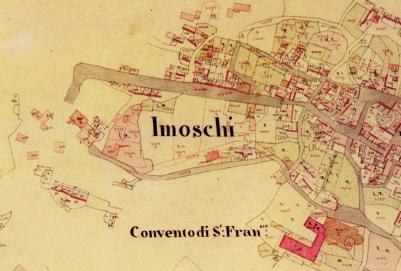 |
Jezero
quarter in 1835
|
The traffic was forbidden in Ante Starčević street in mid 1990-ies
after the street
was covered with white stone from Brač.
Today, it is a promenade connecting Pazar, the center of town to Modro
Jezero main vista.
The street has many well preserved old houses, like Jerković and
Vrdoljak's, including the now closed
town coffee house (Gradska Kavana).
Gradska
Kavana establishment
was a center of
unofficial town life. It had memorable owners in the 20th
century, starting with Manda, continuing with Boško, and finishing with
Kris. The same building housed the town reading
room on the second
floor. On the opposite side of Gradska Kavana it used to be a concrete
surface
were
there was a small open market during the day. It also served as a
small soccer
field.
So called "White House" was built in its place in the 1970-ies that had
offices of "Imotska Krajina" newspaper,
few cultural organizations, and communist party ranking governor's
offices.
The ground floor has a space for cultural happenings that is used to
make performances, exhibitions, and dances.
After the WW II it used to serve as a town cinema. It is again
used for cultural happening like exhibitions, plays, and planning.
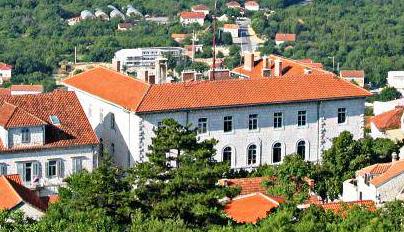 Closer to the lake
is
the administrative part of the town. At the beginning of
the 20th
century, during the rein of Frantz Joseph the County and Court Houses
were built, in 1900 and 1915 respectively.
The Court House is the largest and most beautiful building of its kind
in the wider central Dalmatia region, barring Split. Next to it
there was a Shell gas station when the first automobiles appeared. Closer to the lake
is
the administrative part of the town. At the beginning of
the 20th
century, during the rein of Frantz Joseph the County and Court Houses
were built, in 1900 and 1915 respectively.
The Court House is the largest and most beautiful building of its kind
in the wider central Dalmatia region, barring Split. Next to it
there was a Shell gas station when the first automobiles appeared.
The old court was in Marče house, located
near the St. Francis church belonged to Marče brothers, who were
successful merchants. On both sides on the Vladimir Nazor
street the house is bordered by Kolombani houses. The Colombani's
was one of the oldest Imotski families since the times the census
was performed. They came from Italy after the Venetians with the
help of local population have freed Imotski from Turkish
occupation. Church and Marče and Kolombani houses were at the
border line and were sometimes
considered part of Djirada.
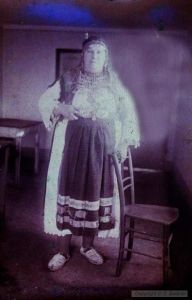 Region
near Modro Jezero is a strict Jezero
quarter. This part of Imotski was well known for its hospital
station, bakery, town bath house, and butchery. That part of the
town has
also seen rememberable inkeepers like Pera Marendić and Kasum. Region
near Modro Jezero is a strict Jezero
quarter. This part of Imotski was well known for its hospital
station, bakery, town bath house, and butchery. That part of the
town has
also seen rememberable inkeepers like Pera Marendić and Kasum.
The families that inhabited Ante Starčević street after WW I, according
to Prof Mostarčić were in order from Volat on the north side: Vrčić,
Bauk (2), Pušić, Jerković, Duzbaba, Bitanga, Šoić (2), Ferari, Rako,
Dubravac, Vrdoljak (2), Bilić, Ivanović and Valdevit. On the
south side from Volat: Benzon, Jelavić, Tripalo, Ligutić, Ciciliani,
Bilopavlović, Skataretiko, Marendić, Nikolić, Ivanović, and Anić.
The families that inhabited the Modro jezero at the same time according
to the same source were Ivanović (4), Malić, Markota, Mirosević,
Protopopov, Nikolić (5), Vodanović, Vujević, Rako (2), Težulat (2), and
Mostarčić. The numbers in the parenthesis denote the number of
families.
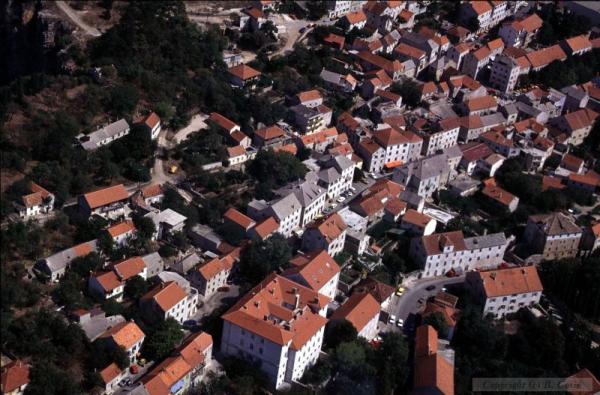 |
Interactive map of Jezero quarter
|
|

